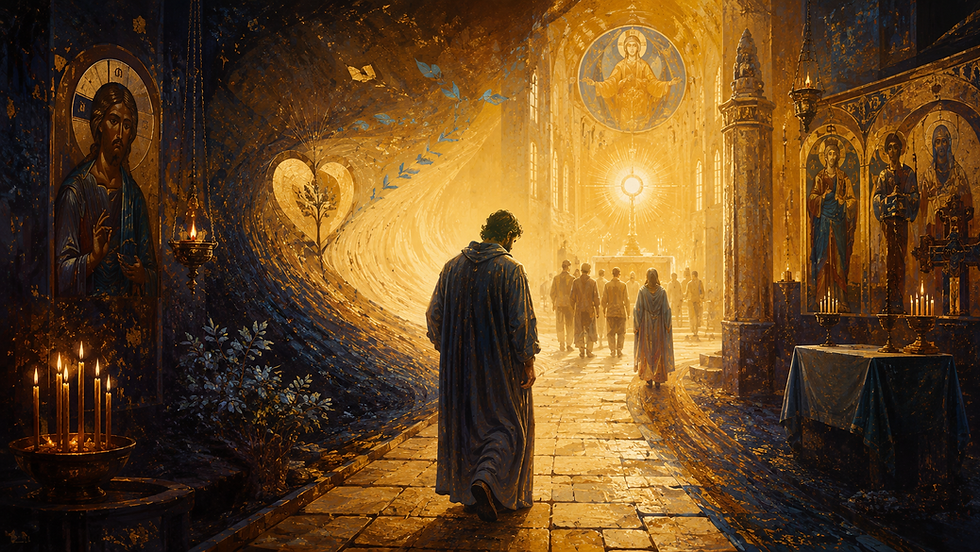
We Do Not Rush Past This Mystery
- Met. John Gregory

- Jan 4
- 6 min read
Lessons: Jer 31:7-14; Ps 84; Eph 1:3-14; Mt 2:1-12
We are still standing inside the mystery of the Nativity. In the East, we do not hurry away from the manger. We stay long enough for the meaning to deepen. Christ has been born, but revelation is not finished. The Incarnation keeps unfolding in time, in lives, in choices that follow encounter.
This Sunday is not about adding another feast or moving the story forward for the sake of motion. It is about what happens after God enters the world and refuses to leave it unchanged.
Jeremiah speaks to people who know what it means to be dislocated. Exile was not only about geography. It was about identity. When you are carried off, scattered, and stripped of familiar rhythms, you begin to wonder who you are without the land, without the temple, without the markers that once held life together. Exile reshapes the imagination. People learn to expect less. They lower their hopes to survive.
Many of us recognize that feeling. Not because we were dragged from our homes, but because life has quietly displaced us. Jobs disappear. Health falters. Relationships fracture. The future stops feeling solid. Over time, people learn how to live smaller. They stop expecting restoration and start managing loss.
Jeremiah speaks directly into that space. God does not address the strong. God names the blind, the lame, the grieving, those who feel they have fallen behind the pace of life. God gathers them. God does not say, fix yourselves and then come home. God says, I will lead you. I will walk with you. I will turn mourning into joy.
This is Incarnation language. God does not save from a distance. God enters the road with people whose strength has worn thin. Restoration does not begin at the destination. It begins with movement, with God present beside them.
Psalm 84 gives voice to what that movement feels like on the inside. This is not confident triumph. This is longing. A soul stretched toward God. A heart that aches for nearness. The psalmist notices birds nesting near God’s dwelling while human beings wait and yearn. There is humility in that image. Creation seems to find rest more easily than we do.
Still, the psalm blesses those whose strength is found in God, not because they feel strong, but because they keep walking. They pass through dry valleys and somehow those places become springs. The road does not disappear. The ache does not vanish. But God meets them along the way.
Then Paul speaks in Ephesians, and he does not slow down. He pours out blessing in a single breath. Chosen. Adopted. Redeemed. Forgiven. Sealed with the Spirit.
This matters more than we sometimes admit. Paul is not writing to people who feel secure. He writes to communities living under pressure. People with limited power. People shaped by economic uncertainty, social instability, and political dominance. They know what it means to feel disposable. Paul does not begin by telling them what to do. He tells them who they already are.
Before the world defines you by productivity, you are chosen. Before scarcity shapes your fear, you are adopted. Before failure names you, you are redeemed.
Before uncertainty marks your future, you are sealed with the Spirit.
This is not optimism. This is identity rooted in God’s action. Paul anchors the Church in what God has already done in Christ so that they are not crushed by the weight of the present moment. Grace is not a future promise alone. It is a present reality that steadies people under strain.
Then we turn to the Gospel. Matthew shows us recognition before understanding. The Magi are not central characters because of a feast or a title. They matter because they respond to revelation without control. They notice a sign and refuse to ignore it. They move without certainty. They cross borders. They ask questions. They risk being wrong.
They enter Jerusalem and do what seekers do. They ask where the child is. Power hears that question and trembles. Herod represents everything threatened by the Incarnation. He is anxious, defensive, calculating. He treats the birth of a child as a threat to his survival.
The Magi, by contrast, treat the same news as an invitation. They continue on, not because they have clarity, but because they have attention. When they arrive, they do not demand proof. They kneel. They recognize something holy hidden in ordinary flesh. They offer gifts that speak truth rather than convenience. Gold, acknowledging a kingship the world does not yet see. Incense, honoring divine presence wrapped in vulnerability. Myrrh, refusing to sentimentalize love by denying suffering. This is revelation without spectacle.
God does not reveal Christ through force or dominance. God reveals Christ through vulnerability. Through a child dependent on care. Through a family living under threat. Through witnesses who are willing to be changed by what they encounter.
And they are changed. They leave by another way. That line is not poetic excess. It is theological clarity. Encounter alters direction. Recognition reshapes allegiance. You do not meet Christ and return unchanged. You do not bow before divine vulnerability and continue serving systems built on fear and control. This is where the Incarnation presses into our present reality.
We live in a world shaped by anxiety. Economic pressure is constant. The cost of living rises. Security feels fragile. Many carry these concerns quietly. Faith can feel disconnected from daily survival, like something meant for reflection rather than resilience.
Scripture refuses that separation. God gathers people who feel scattered. God blesses longing rather than shaming it. God names identity before circumstances improve. God entrusts revelation to those who move in trust, not those who cling to power.
The Incarnation confronts false power. It exposes systems built on fear. It reorders what we serve and how we live. The Church does not announce Christ as an idea. The Church bears witness to Christ as presence. Present in uncertainty. Present in loss. Present on the road.
So this Sunday asks us something honest. Where has Christ been made known to you quietly, without spectacle, in ways easy to dismiss? What longing have you learned to suppress instead of bringing before God? What path might God be redirecting, not with force, but with invitation? The Nativity has not ended. Christ continues to be revealed. Not once, but again and again. In people who keep walking. In faith that moves without certainty. In lives reoriented by grace. We do not rush past this mystery. We remain. We watch. We walk differently. And this brings us to the vocation of the Church.
Not as an institution guarding memory, but as a people shaped by presence. The Church exists because Christ has entered the world and refuses to withdraw. Our calling is not to manage holiness or preserve nostalgia. Our calling is to bear witness to a God who gathers, restores, and walks with people still finding their way home.
The Church stands with those who feel scattered. With those worn down by economic pressure. With those who no longer trust promises because too many have failed. We do not offer certainty where God has not given it. We offer companionship. We walk beside people as God walks beside us.
Incarnation does not produce spectators. It forms witnesses. The Magi did not stay to build something impressive. They left changed. Israel did not return from exile to recreate the past. They returned to rebuild life differently. The Church does not exist to reclaim power. It exists to reveal Christ through fidelity, humility, and courage shaped by love.
We show the world who God is by how we walk, how we wait, how we refuse fear as our master.
And so we return once more to Jeremiah. God does not simply bring people back to where they were. God brings them home changed. With scars. With wisdom. With a deeper dependence on grace. God gathers those who thought they were forgotten and leads them by a straight path, not because the road is easy, but because God walks it with them. Home is not nostalgia. Home is restored relationship. Home is belonging rebuilt by mercy. That is what the Incarnation continues to do.
Christ is born into the world and into our lives not to leave things untouched, but to draw us back together. To gather what was scattered. To heal what was worn thin. To turn mourning into joy without denying the truth of grief.
We do not rush past this mystery. We stay long enough to be changed. We walk long enough to be gathered. We trust long enough to find our way home.
Glory to the Father, and to the Son, and to the Holy Spirit, now and forever. amen