
The Wounded Fathers and the Creed We Still Carry

Christ is risen.
Truly, he is risen.
On the seventh Sunday of Pascha, the Church remembers the Holy Fathers of the First Ecumenical Council. At first glance, that might sound like a strange thing to place inside the Paschal season. We are still standing in the light of the empty tomb. We are still proclaiming resurrection. We are still singing that death has been defeated and that Christ has passed from death to life.
And then the Church gives us Nicaea.
Not as a pause from resurrection.
Not as a dry history lesson.
Not as a feast for theologians only.
The Church gives us Nicaea because Pascha raises the deepest question of the Christian faith.
Who is this risen One?
Is he only a prophet? Is he only a holy teacher? Is he a created messenger sent by God? Is he near God, but not truly God?
Or is he, as the Church confessed, true God from true God, Light from Light, begotten not made, of one Being with the Father?
The Council of Nicaea answered that question. But the feast is not only about the Council as an event. It is about the Fathers who gathered there.
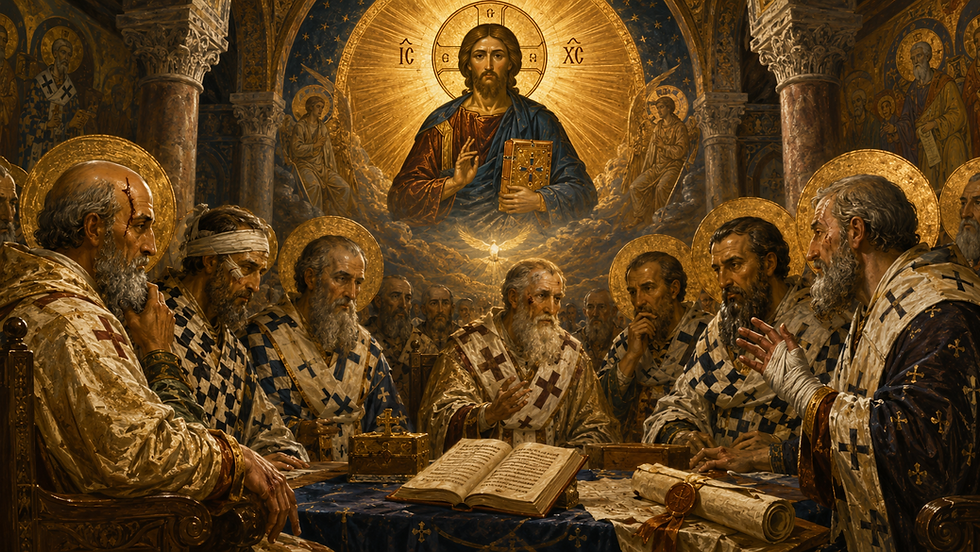
This is where the Eastern Church helps us see the day clearly. The hymns of the East do not let us imagine the Fathers of Nicaea as clean, distant, polished religious officials sitting comfortably in a theological conference. The tradition remembers them as confessors. These were men who had already suffered for Christ. Bishops and elders who had come through the fires of persecution. Some had been imprisoned. Some had been beaten. Some had lost an eye. Some had hands or limbs damaged by torture.
They came to Nicaea carrying wounds.
That changes how we hear this feast.
The Creed was not born in comfort. The confession of Christ’s full divinity was not shaped by men trying to win an academic argument. It was carried by wounded shepherds who had already paid for the name of Jesus with their bodies.
Their theology had skin in it.
Their doctrine had scars.
Their confession had cost them something.
That should humble us.
Much of the modern Church argues from comfort. We argue from opinion. We argue from anxiety. We argue from institutional fear. We argue from the need to win. We argue from the need to be right.
The Fathers of Nicaea remind us that the deepest confession of the Church is not shouted from pride. It is carried by those who have been faithful under pressure.
They teach us that orthodoxy is not merely correct language. Orthodoxy is right worship, right glory, and right life. It is the whole self turned toward Christ. Mind, heart, body, wound, memory, and hope.
The first reading from Wisdom gives us the language for this. Wisdom is described as holy, clear, unpolluted, loving the good, all-powerful, and overseeing all things. She is called a reflection of eternal light, a spotless mirror of the working of God, and an image of divine goodness. Wisdom reaches from one end of creation to the other with strength, and she orders all things with gentleness.
Strength and gentleness.
That is not how the world usually understands power.
The world teaches us that power means control. Power means force. Power means winning. Power means getting your way.
But divine Wisdom is different.
Divine Wisdom is strong without being cruel. Clear without being cold. Pure without being fragile. Powerful without being violent.
And in Christ, this Wisdom has taken flesh.
Jesus does not reveal a God addicted to domination. Jesus reveals the God who is love. He reveals God by touching lepers. By eating with sinners. By defending the shamed. By blessing children. By weeping at graves. By washing feet. By forgiving from the cross.
That is what Nicaea protects.
Nicaea protects the truth that when we look at Jesus, we are not looking at a servant sent from far away. We are seeing the face of God.
That is why the Fathers stood so firmly. They knew a smaller Christ would give the Church a smaller Gospel. They knew a lesser Christ would leave the world only partly healed. They knew that if Christ were not truly God, then God had not truly come near.
And the wounds on their bodies preached that truth before their mouths ever spoke it.
Psalm 140 brings another kind of honesty. It is not a gentle Psalm. It is the prayer of someone surrounded by danger. Someone who knows what violence does. Someone who has felt the poison of wicked speech and the trap of arrogant power.
“Deliver me, O Lord.”
“Protect me.”
“Do not grant the desires of the wicked.”
That is not polite religion. That is prayer from the underside of life. It is a prayer from the hunted. A prayer from the harmed. A prayer from the person who does not have the luxury of pretending everything is fine.
That Psalm belongs on this feast because the Fathers knew what it meant. They had prayed with their bodies. They had prayed with bruises. They had prayed in prison. They had prayed when the empire tried to make them afraid. They had prayed when the cost of faith was not theoretical.
And the Church still needs this Psalm.
Many people come to Church wounded.
Not always with visible wounds. Some wounds are carried in the nervous system. Some are carried in memory. Some are carried in shame. Some are carried from families, churches, systems, and leaders who should have protected but instead harmed.
Some wounds come from grief.
Some from rejection.
Some from racism.
Some from poverty.
Some from spiritual abuse.
Some from years of being told that the table of Christ had no room for them.
And some wounds are more ordinary, but no less real.
People come to church after a week of bad news, high prices, family tension, political noise, medical appointments, work stress, and quiet exhaustion. People come carrying bills they cannot quite cover. Children they are worried about. Parents they are caring for. Relationships that feel fragile. Anger they do not know where to put. Fear they have learned to keep private.
We know what it is to live in a time when powerful people use religious language while ordinary people pay the cost. We know what it is to feel like truth is being bent in public and compassion is being treated like weakness. We know what it is to wonder whether the Church has the courage to be faithful or whether it will settle for being acceptable.
That is why this feast is not far away from us.
The Fathers came with visible wounds from an empire that hated their confession. Many today come with hidden wounds from systems, families, churches, and powers that still demand silence, compliance, and fear.
The wounds are not the same.
But the lesson carries.
The Fathers of Nicaea stand before us and say, “Bring the wounds too.”
Do not bring only your polished faith. Do not bring only your best words. Do not bring only your Sunday face.
Bring the eye that has seen too much. Bring the hand that has grown weak from labor. Bring the heart bruised by betrayal. Bring the body that carries pain. Bring the faith that survived, even if it limps.
The Creed was entrusted to a wounded Church.
And the wounded Church still confesses.
We believe.
Not because we escaped suffering.
We believe because Christ has entered suffering.
We believe because the crucified One is risen.
We believe because the eternal Son has taken our flesh and carried it into glory.
In Acts, Paul speaks to the elders of Ephesus with the weight of final counsel. He tells them, “Keep watch over yourselves and over all the flock.”
The order matters.
Keep watch over yourselves first.
Before you guard the flock, guard your own soul. Before you correct the Church, examine your own heart. Before you speak in the name of God, kneel before God.
Paul warns them that fierce wolves will come. Some from outside. Some from within.
That is the harder truth.
The danger is not always out there.
Sometimes the danger wears vestments. Sometimes it sits in council. Sometimes it speaks with confidence. Sometimes it knows the right words. Sometimes it says the Creed with its mouth while contradicting Christ with its life.
This is why the feast of the Fathers of Nicaea matters so much. They were not defending doctrine as an intellectual exercise. They were keeping watch over the flock.
They knew that a false Christ harms the sheep. They knew that a diminished Christ diminishes salvation. They knew that when the Church gives people a smaller Jesus, the Church gives people a smaller hope.
Paul tells the elders to care for the Church of God. The Church obtained through the self-giving life of Christ.
That line should bring every pastor, priest, bishop, deacon, catechist, and leader to silence.
The Church does not belong to us. The people do not belong to us. The altar does not belong to us. The sacraments do not belong to us. The Gospel does not belong to us.
We are stewards.
And stewardship requires humility. It requires clean hands. It requires courage. It requires love for the weak.
That is what faithful leadership looks like.
Not control. Not performance. Not a polished image. Not building a name.
Faithful leadership protects the vulnerable, tells the truth, works with clean hands, and gives itself away.
The Fathers came to Nicaea as wounded shepherds. They did not guard the flock by domination. They guarded the flock by confession.
Not perfect bodies.
Faithful witness.
Not comfort.
Cost.
Not pride.
Courage.
And that word to shepherds becomes a word to the whole Church.
It is possible to defend orthodoxy and forget mercy. It is possible to love liturgy and neglect the poor. It is possible to speak of unity while silencing the wounded. It is possible to honor councils while refusing accountability. It is possible to say all the right words about Christ and then treat Christ’s people as disposable.
Paul will not let us do that.
The Fathers will not let us do that.
The risen Christ will not let us do that.
Doctrine is not only something we recite.
Doctrine is something we become accountable to.
If we confess that Jesus is true God, then every human being he touched with mercy matters.
If we confess that the Word became flesh, then bodies matter. Hungry bodies. Trans bodies. Disabled bodies. Black and brown bodies. Immigrant bodies. Sick bodies. Aging bodies. Children’s bodies. Bodies sleeping on sidewalks. Bodies sitting in pews wondering whether the Church has room for them.
If we confess Jesus as Light from Light, then we do not make peace with darkness.
If we confess him as true God from true God, then no nation, party, bishop, priest, institution, or ideology gets our highest allegiance.
If we confess that he was crucified, suffered death, and was buried, then we must stand near the crucified people of our own time.
If we confess that he rose again, then despair does not get the final word.
John 17 brings us onto holy ground. Jesus prays.
He is near betrayal. Near arrest. Near the cross. Near the violence of the world doing what violence always does.
And instead of turning inward, he prays for those entrusted to him.
“Father, the hour has come. Glorify your Son, so that the Son may glorify you.”
In John’s Gospel, glory does not mean applause. It does not mean success. It does not mean domination. Jesus is speaking of the cross.
The glory of God is revealed in self-giving love.
The glory of the Son is not escape from suffering. It is faithful love inside suffering.
Then Jesus says eternal life is this, to know the only true God, and Jesus Christ whom God has sent.
Not merely to know about God.
To know God.
To live in communion with God.
To be drawn into the life shared by the Father, the Son, and the Holy Spirit.
This is why Nicaea matters.
If Jesus is not truly God, then eternal life is not communion with God in Christ. It is only information about God. Or obedience to a messenger. Or loyalty to a spiritual representative.
But the Gospel gives us more.
The Gospel gives us union.
The Son shares the Father’s life. The Son gives life to us. The Son brings us into communion with God. The Son prays for us.
And then Jesus says, “Holy Father, protect them in your name that you have given me, so that they may be one, as we are one.”
Protect them.
Make them one.
This prayer deepens everything we have said about the Fathers of Nicaea.
God’s protection did not mean they escaped suffering. Some of them did not. God’s protection did not mean their bodies remained untouched. Some were mangled. Some were marked for life.
But protection in Christ is deeper than avoidance of pain.
Sometimes God protects faith when the body is broken. Sometimes God protects courage when fear is real. Sometimes God protects the Church by raising up wounded witnesses who refuse to hand down a lesser Gospel. Sometimes God protects unity not by removing conflict, but by leading the Church through conflict into truth.
The unity Jesus prays for is not cheap unity. It is not pretending. It is not institutional quiet. It is not everyone being forced into sameness. It is not peace without justice. It is not silence in the face of harm.
Jesus prays that we may be one as he and the Father are one.
That is communion.
That is love rooted in truth.
That is unity without erasure.
That is difference held in divine life.
So the Church’s unity cannot be a flattening. It cannot be one tradition swallowing another. It cannot be enforced by fear. It cannot be built on exclusion. It cannot be maintained by ignoring wounds.
True unity is Paschal.
It passes through death into life. It tells the truth. It bears wounds. It forgives. It repents. It gathers. It confesses Christ.
This is why the Fathers of Nicaea matter for Convergent Catholics.
We are a people who speak often of convergence. East and West. Ancient and modern. Sacramental and evangelical. Contemplative and charismatic. Tradition and renewal.
That sounds beautiful.
But it is not easy.
Unity without sameness requires maturity. It requires patience. It requires a common center.
And that center cannot be our preferences. It cannot be our personalities. It cannot be our favorite liturgical style. It cannot be our politics. It cannot be our wounds, though our wounds must be honored.
The center is Christ.
True God from true God.
The crucified and risen Lord.
The eternal Wisdom of God.
The one who prays that his people may be one.
So the lesson of this feast is not that we must become ancient bishops. The lesson is that we must become faithful witnesses where we are.
In our homes. In our parish. In our friendships. In the way we speak online. In the way we handle disagreement. In the way we treat people whose wounds make us uncomfortable. In the way we refuse to use truth as a weapon. In the way we refuse to use mercy as an excuse for dishonesty.
The Fathers guarded the faith in council.
We guard it in daily life.
We guard it when we refuse a smaller Christ.
We guard it when we refuse a smaller mercy.
We guard it when we choose patience over cruelty.
We guard it when we tell the truth and still keep our hearts soft.
We guard it when we make room at the table for the people Christ has already welcomed.
Every time we say the Creed, we are doing more than reciting doctrine. We are standing inside a wounded inheritance.
We stand with the Fathers of Nicaea. We stand with the martyrs. We stand with the myrrhbearers. We stand with Thomas touching the wounds. We stand with Paul warning the elders. We stand with generations who did not have perfect understanding but had stubborn faith.
And we stand with those today whose faith is still wounded, still limping, still searching for a Church that looks like Jesus.
When we say, “true God from true God,” we remember that God has come all the way to us.
When we say, “begotten, not made,” we remember that Christ is not one more creature trying to help us find God. He is God with us.
When we say, “of one Being with the Father,” we remember that Jesus does not merely point to God. He reveals God.
When we say, “for us and for our salvation,” we remember that we are included in that “us.”
Not the polished version of us.
Not the version that has all the answers.
Not the version that never doubts.
Us.
With our grief. With our history. With our wounds. With our hope. With our fear. With our longing to be made whole.
The Fathers came to Nicaea bearing wounds from the empire. They left bearing words for the Church.
And we still stand inside those words.
Not as a museum piece. Not as a theological slogan. But as the confession of a wounded people who have met the risen Christ and know that he is God with us, God for us, and God saving us all the way down.
That is the invitation of this feast.
To confess Christ truly.
To guard the flock humbly.
To seek unity honestly.
To bring our wounds into the light.
To trust that resurrection does not erase the scars, but transfigures them.
After all, the risen Christ still had wounds.
Thomas touched them. The disciples saw them. The glorified Lord did not return without marks.
That means our wounds are not outside the reach of glory.
The Fathers of Nicaea knew that. Their maimed bodies stood as icons of a deeper truth.
The empire wounds.
Christ raises.
The world threatens.
Christ sustains.
Falsehood divides.
Christ gathers.
Death destroys.
Christ is risen.
So let us keep watch over ourselves. Let us keep watch over the flock. Let us guard our tongues from poison. Let us protect the vulnerable. Let us speak truth without hatred. Let us seek unity without dishonesty. Let us hold doctrine with humility. Let us hold one another with mercy.
The Creed was entrusted to a wounded Church.
And the wounded Church is still being healed by the risen Christ.
To him be glory, with the Father and the Holy Spirit, now and forever. amen.


