Proetoimasía: The Pharisee and the Publican
- Fr. Columba

- Jan 29
- 4 min read
Lessons: Sir 35:12-17; Ps 64; 2 Tim 4:6-8, 16-18; Lk 18:9-14
Today the Church places before us the Sunday of the Publican and the Pharisee. A publican, for those who may not know, is simply an old-fashioned word for a tax collector.
This is one of the Sundays that prepares us for Lent. We call this season Pre-Lent, or Proetoimasía. It is a winding up. A foretaste. A season that already carries the emphases of Lent itself: humility, repentance, fasting, and honest self-examination. Before the great fast begins, the Church gives us time to get our bearings.
And she begins here.
When we hear this Gospel on Sunday, we receive only a few verses. A snippet. Scripture never lives in isolation, and this parable cannot be understood well unless we widen the frame.
First, we need to understand where publicans and Pharisees fit within their society.
Publicans were outcasts. They were collaborators with an occupying empire. Rome ruled Judea through violence, taxation, and political control, propped up by client rulers like Herod. Tax collectors worked for that system. They handled pagan money. They dealt constantly with Gentiles, idols, and Roman authority. For many Jews, this made them ritually unclean and morally compromised.
And that is why the Gospels repeatedly tell us that Jesus ate with tax collectors and sinners. This was not a throwaway detail. It was scandalous. How could someone claiming to be God’s Messiah associate with collaborators of an occupying force and with those considered spiritually impure?
At the same time, the publicans were not innocent victims. Many exploited their position. Many became wealthy through corruption. The parable does not erase that reality. What it does highlight is awareness. The publican knows who he is.
Then there are the Pharisees.
We often forget that first-century Judaism was deeply diverse. There were Sadducees, focused on the Temple and the priesthood, who accepted only the first five books of Moses. There were Pharisees, rooted in synagogue life, committed to holiness, to the Law, and to the developing rabbinic tradition. There were Zealots who wanted violent revolution. Essenes who withdrew into the desert. Hellenistic Jews who blended Torah and Greek philosophy, many of whom later became Christians.
After the destruction of the Temple in 70 AD, the Sadducees disappeared. Pharisaic Judaism survived. Which means that nearly every Jewish person today stands in the Pharisaic tradition.
That matters.
When Christians casually use “Pharisee” as an insult, we are not being clever. We are being careless. To Jewish ears, we are simply insulting Jews.
So the sin in this parable is not being a Pharisee. The sin is not devotion to the Law. The sin is pride.
The Pharisee takes what is good and turns it inward. He wears his faith as a badge of honor. His religion becomes proof of his superiority.
Now look at where this parable sits in Luke’s Gospel.
Jesus has just spoken about the coming Kingdom of God. Then he tells the parable of the persistent widow, the lowest of the low in a patriarchal society. A woman without protection, income, or standing, demanding justice from an unjust judge.
Then comes the publican and the Pharisee.
After that, Jesus welcomes little children. Not symbols of innocence, but property in the ancient world. Disposable. Owned by the father. Without status.
Then Jesus condemns the rich.
In one movement, Jesus overturns every social hierarchy. Judges. Clergy. Adults. The wealthy.
This is not sentimental religion. This is disruption.
And at the center of it all is prayer.
The Pharisee enters the Temple in confidence. He looks the part. Sounds the part. His prayer is polished. And yet it is entirely about himself. He thanks God for not being like others. His worship becomes comparison. His faith becomes performance.
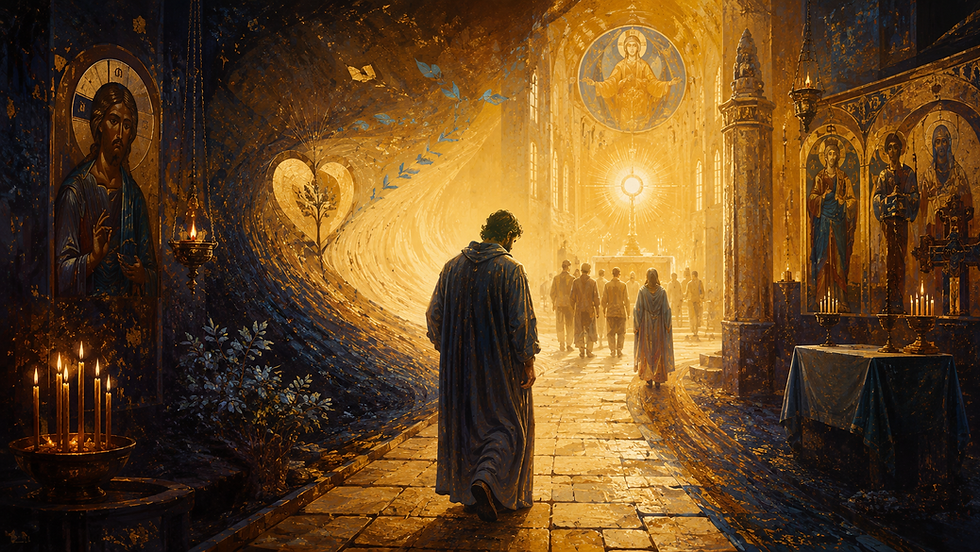
The publican stands far off. He does not posture. He does not justify himself. He does not speak at length. He beats his breast and says one sentence.
God, have mercy on me, a sinner.
That prayer is the foundation of Catholic worship East and West. When we pray Kyrie eleison, Lord have mercy, we are praying the prayer of the publican. Over and over. Not because God forgets, but because we do.
This is not about self-hatred. It is not about obsessing over sin. The Church has seen that distortion too, people crushed under guilt, even harming themselves in the name of repentance. That is not what this parable teaches.
Humility is honesty. It is naming what is broken and handing it to God. It is taking the burden off our shoulders and placing it on the cross.
I have watched pride hollow out churches. Beautiful liturgies. Correct theology. But pride seeps in, and worship becomes theater. Prayer becomes about looking faithful instead of being faithful.
Scripture is relentless about this.
Proverbs warns that pride brings a fall. Isaiah says God dwells with the lowly. Jesus says the child is greatest. Mary sings of rulers cast down and the humble raised.
The pattern never changes.
And it does not stop with individuals.
We live in a culture that confuses size with faithfulness. Megachurches are praised. Small communities are dismissed. Multinational corporations are celebrated. Mom-and-pop shops are ignored. Political power is glorified. Nations declare themselves supreme.
That is pride.
Every empire believes it stands at the top of the food chain. Every empire eventually falls. Babel. Egypt. Israel itself. Rome. The pattern repeats because the lesson is ignored.
This parable speaks to churches, families, workplaces, and nations alike. When we forget our place, God reminds us.
That is why the Church begins Lent here. Not with ashes. Not with fasting rules. With posture.
Proetoimasía is preparation of the heart.
This week, we are called to stand where the publican stood. To pray what the publican prayed. To trust that mercy does the work we cannot.
Grace is gift.
It is not earned.
It is not seized.
God, have mercy on me, a sinner.
That prayer still opens the Kingdom.
In the name of the Father, and of the Son, and of the Holy Spirit.
Amen.