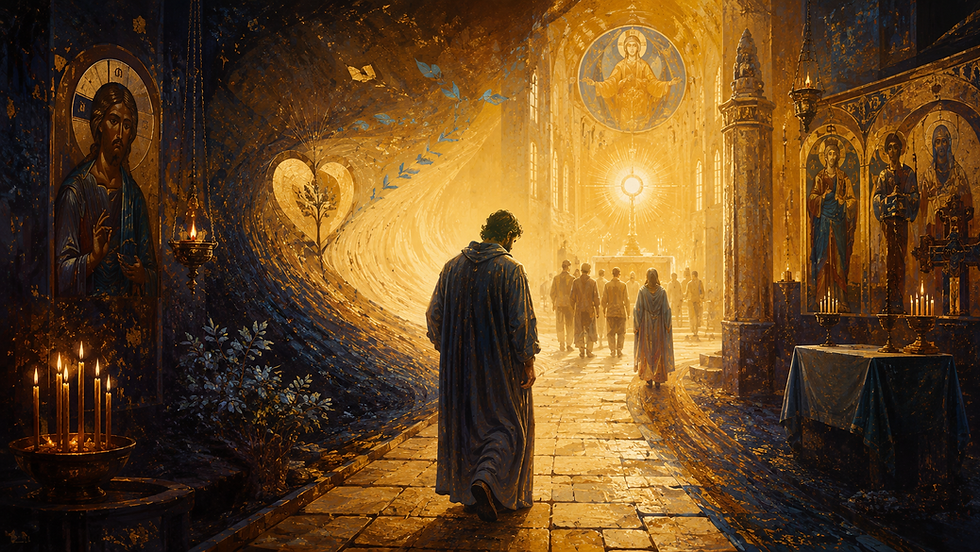
Honoring the Living and the Dead: A Reflection for All Saints and All Souls
- Fr. Columba

- Nov 3, 2025
- 4 min read
Preacher: Fr. Columba
Lessons: Ecc 44:1-14 or Rev 7:9-17; Ps 149; Eph 1:(11-14)15-23; Lk 6:20-26(27-36)
Today we celebrate the Feast of All Saints, and by happy coincidence, it aligns with All Souls Day. These two observances belong together, inviting us to remember the holy ones of every age, the martyrs and mystics, and the faithful who lived quiet, uncelebrated lives of love and devotion.
In the early Church, there were so many saints, so many martyrs, and so many local feast days that the calendar became crowded and confusing. To bring order and unity, the Church began to set aside one great day to honor them all. Over time, that day grew to include not just the martyrs but all those who lived holy lives in service to Christ. The meaning of “saint” is simply “holy one,” and holiness is not limited to the few whose names appear in history books. It is found in every faithful person who reflects the love and mercy of God in their life.
When we celebrate All Saints, we are not only honoring those whose icons hang on our walls or whose names fill the calendar. We are honoring those who showed us Christ in everyday ways. We remember the ones who prayed for us, taught us to love, and carried us through difficult times. Many of us have those saints in our families and in our memories. For me, that includes my Aunt Debbie, who took my brother and me to church when we were young. Even when my parents were not deeply involved in church life, she made sure faith was part of ours. It has been nearly twenty years since she gave me my first Bible, and her example of devotion still shapes me.
I also think of my godmother, Emma. Her life was hard. She endured poverty, rejection, and pain, even being cast out by her church when she became pregnant as a teenager. Yet she never turned her back on God. She was gentle, humble, and steadfast in her love for Christ. When I think about the saints, I think of people like Emma—those who loved despite hardship and kept the faith when it would have been easier to walk away.
Scripture itself is the story of the saints. The prophets, apostles, and martyrs whose writings fill the Bible are people who knew God intimately. Some walked beside Jesus, others wrestled with him as Jacob did, and some gave their lives for their faith. The saints in Scripture teach us how to live holy lives. When we read the Beatitudes in the Gospel—blessed are the poor, the meek, the merciful—we are seeing a picture of what it means to be a saint.
But we must also remember that Scripture did not appear out of thin air. It came to us through the living tradition of the Church. Every culture, every regional church, has its own witness and version of the story. The saints helped shape that tradition, carrying the faith forward through the centuries. It is not a dusty record of the past but a living stream that flows into our present. The liturgy we celebrate today carries their voices. The prayers of St. John Chrysostom, St. Basil, St. James, and St. Mark are still on our lips every time we worship. When we gather in prayer, we are participating in that same holy tradition that shaped them.
All Saints and All Souls are not just about the past. These days remind us that holiness is not finished. It continues in us. We are surrounded by a great cloud of witnesses, and we are invited to join them by the way we live. The saints were not perfect. They struggled with sin, doubt, and fear, yet they kept their eyes fixed on Christ. That same call comes to us.
Dorothy Day once wrote that people will imitate movie stars or politicians, but few desire to imitate the saints. That should challenge us. The saints were not famous because of power or wealth but because they loved deeply and lived truthfully. They were willing to confront injustice, to speak out against corruption, and to lay down their lives for the sake of others. That courage is still needed in our world today.
We are called to be prophetic. To challenge the powers and systems that diminish life. To remember that Christ is the true King, and no earthly power can stand above him. Many of the early saints died because they refused to bend to unjust rulers. Later saints like Dietrich Bonhoeffer and Maximilian Kolbe faced death for the same reason. They understood that to follow Jesus sometimes means to stand apart from the crowd, even when it costs everything.
So how do we honor the saints? We read Scripture. We pray. We come together in worship. But we also honor them by living as they lived. By forgiving when it is difficult, by serving when no one is watching, by speaking truth when silence feels safer. The saints remind us that holiness is not a distant goal but a daily practice.
As we leave our celebration today, I want to give you a bit of homework. Think about the saints in your own life. Think about the people who showed you Jesus by how they lived. Spend time in prayer this week, as the saints did. Open the Scriptures and let their example speak to you. Let the tradition of the Church guide you and strengthen your faith. And then go out into the world and be Christ to someone else.
Each of us may be the only image of Jesus that someone ever sees. Each of us has the power to bring light into a place of darkness. So as we honor all saints and all souls, let us not only remember the dead but also live as the living saints of God, bearing witness through love, mercy, and service.
Amen.